
From Gatekeeper to Risk Steward: Redefining Legal’s Role in Tech-Driven Organisations

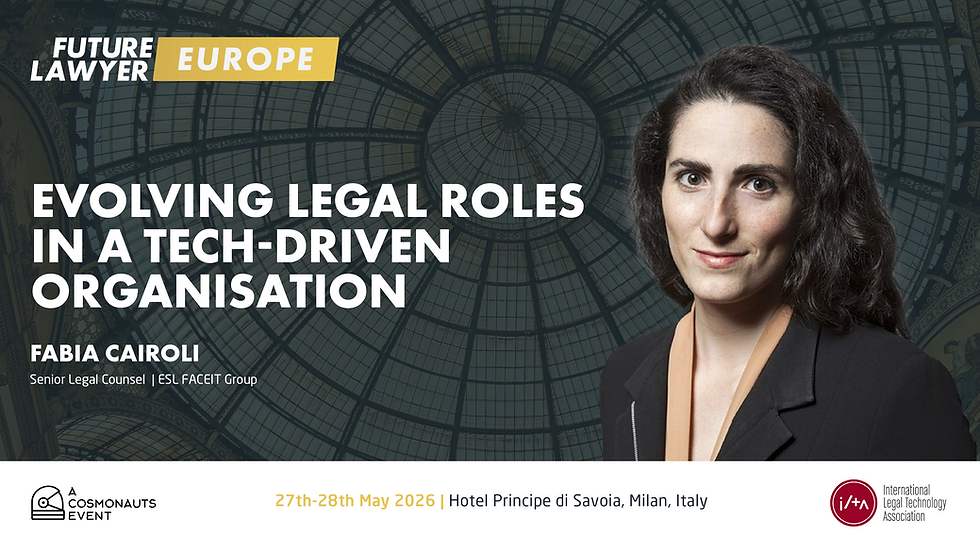
Technology-driven organisations are reshaping how legal teams operate, placing greater emphasis on speed, integration, and strategic contribution.
Fabia Cairoli, Senior Legal Counsel at ESL FACEIT Group, shares her perspective on how legal innovation can move beyond efficiency to become a structural and cultural shift within the business.
In this Q&A, Fabia reflects on AI adoption, the evolution from gatekeeper to risk steward, and the skills future lawyers will need to balance automation, judgment, and business impact.
Enjoy the interview below.
1. How do you define “legal innovation” and what does it mean in the context of a large, technology-driven organisation?
To me, legal innovation is the strategic integration of tools and processes to liberate lawyers from administrative friction, allowing us to focus on high-impact work. In a large, technology-driven organisation, we must optimise our efforts across three value tiers:
Automation: routine tasks like formatting and presentation design can (and should) be automated. This levels the field, ensuring lawyers are judged on substance rather than their ability to ‘gift wrap’ information.
Augmentation: for evolving fields like those regulated by the AI Act or the GDPR, AI is an essential research partner. However, human verification remains non-negotiable; our duty is to provide accurate advice.
Strategic human insight: AI relies on precedent, but business requires navigating the unprecedented. True innovation lies in preserving our time for the 'yes, but' and 'no, unless', the nuanced, creative risk management that bridges legal constraints with business reality.
However, innovation is more than just efficiency; it is structural and cultural. In a tech organisation, legal must move from being a reactive 'gatekeeper' to an embedded partner, baking legal guardrails into the product lifecycle itself. True innovation is a change management exercise: we must foster a culture that views legal not as a blocker, but as a strategic asset that allows the business to move more safely and secure the models used to create value.
2. How do you strike an effective balance between encouraging innovation and ensuring legal compliance and risk management?
Striking this balance requires a shift in mindset: moving from the traditional, often paternalistic role of ‘legal gatekeeper’ to that of a ‘risk steward.’ To foster innovation without sacrificing compliance, I focus on two core pillars:
(a) A risk-based framework: we must discard the binary ‘yes/no’ mentality. Not all risks carry the same weight. By segmenting our workflow, automating low-risk, high-volume compliance tasks while reserving our ‘human-only’ hours for high-stakes, strategic counsel, we create an environment where the business can innovate safely. We don’t apply the same level of scrutiny to all matters; treating everything with the same intensity is not ‘being safe’, it is a bottleneck.
(b) The human intervention: technology is a force multiplier, not a replacement for judgment. I believe the ‘death of the professional’ occurs the moment we use AI to abdicate our responsibility. Innovation thrives when AI handles the data and the heavy lifting, but the ‘human-in-the-loop’, the nuanced application of ethics, context, and creative problem-solving, remains our domain.
Ultimately, innovation and compliance are not opposing forces. By using AI to clean up the operational noise, we actually liberate ourselves to do what machines cannot: provide the strategic, ethical judgment that defines true legal counsel.
3. What skills and competencies do you believe will be essential for future lawyers specialising in data and privacy?
This is a critical question for our generation. I believe we are facing a ‘training crisis’ disguised as an efficiency gain.
There are two distinct dangers here:
The cognitive reduction of the next generation: if junior lawyers rely on AI for drafting and research without first enduring the ‘grind’ of manual analysis, they never build the mental muscle memory required to verify outputs. You cannot detect a hallucination or a nuance if you don’t understand the fundamental legal principles yourself. AI is a powerful supplement, but it is a dangerous substitute for foundational reasoning.
The erosion of mentorship: we are seeing a shift where seniors, seduced by the speed of AI-generated drafts, are losing the incentive to train juniors. This is a strategic error. A machine can draft a clause, but it cannot mentor a human, nor can it provide the ‘human friction’, the creative pushback and context, that separates a compliant legal opinion from a truly strategic one.
The lawyers of tomorrow will not need to be better at researching than machines. Instead, their core competencies will (probably) be:
Foundational rigour: we must double down on the ‘old school’ basics. You cannot effectively audit an AI’s work if you don’t know how to do the work yourself. There are no shortcuts to becoming a trusted advisor: we all need to study and learn.
Critical verification: the ability to trace an AI’s logic and challenge its conclusions.
Human contextualisation: bridging the gap between the ‘black-and-white’ legal output of an algorithm and the grey-area reality of business strategy.
4. What advice would you offer to individuals who are interested in pursuing a career in data protection and privacy law?
Whether you are in-house or in a law firm, the foundation remains the same: technical rigour, deep curiosity, and the ability to simplify complexity. As Einstein (I think it was him!) suggested, if you cannot explain it to your grandmother, you don't understand it well enough. This is a principle that remains the ultimate test even in the age of AI.
However, the primary competencies shift depending on the environment.
In-house, the priority is 'strategic and relational intelligence'. You must understand the business architecture, see how your legal input affects operational speed, and take true accountability for decisions. It is about knowing where the 'legal' lane ends and the 'business' lane begins, and then finding the safest path for the organisation. We must stop defaulting to other functions and instead take ownership of (some) risks.
In a law firm, the value proposition is defined by deep technical acumen and market foresight. Here, the expectation is to master the regulatory framework, anticipate the 'vibe' of the regulators, and set the gold standard for market practice. You are there to provide the specialist depth that the internal business machine often cannot afford to build itself.
5. In your opinion, what personal qualities and professional attributes are most important for success in a legal role within a fast-paced company?
Success in a fast-paced, high-growth environment requires a hybrid skill set: one part technical expert and one part business diplomat.
The personal attributes: beyond legal acumen, I value relational intelligence and strategic curiosity. In a fast-paced company, the legal team cannot be an ivory tower. You must have the ability to build genuine, cross-functional relationships. You are essentially the person ‘oiling the mechanism’, understanding the business’s ultimate objective so you can align legal frameworks with commercial speed. Also, I personally very much value humility in understanding that legal services serve business purposes: we must be able to adapt to business needs to offer the best support possible.
The professional attributes: there is a common debate between being a ‘deep expert’ versus a ‘strong manager.’ I believe the ideal is a mix. While a leader doesn't need to be the deepest specialist in every niche, they must possess high subject-matter literacy. One needs enough foundational rigour to audit external counsel and mentor internal specialists. Without this, one cannot distinguish between a conservative ‘no’ and a strategic ‘yes.’ Ultimately, one must be confident enough to push boundaries and intuitive enough to know when to pull back. The best lawyers in this context are those who can synthesize complex legal risks into clear, actionable business guidance.
Fabia’s insights highlight a shift in how in-house legal teams create value. By combining technology with human judgment and embedding legal into business processes, lawyers can support innovation while maintaining accountability and control.
Fabia will be joining Future Lawyer Europe Italy 2.0 Day 2 for a fireside chat, “The Next Generation of In-House Talent”, exploring the skills that will define future lawyers and how organisations can develop talent to thrive in a technology-enabled environment.
Register now to join the discussion at Future Lawyer Europe - Italy 2.0.


Comments